
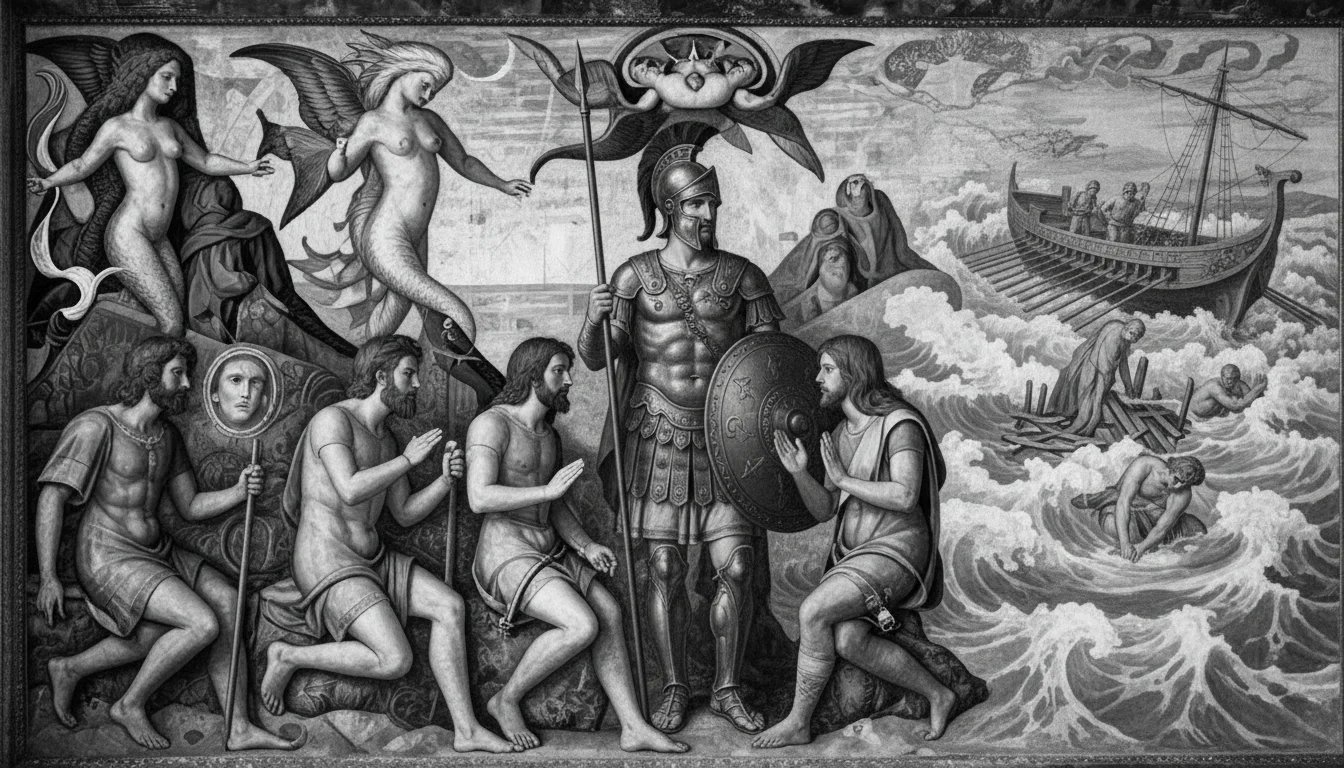
Odysseus’s journey Explained
Odysseus’s journey home reads beautifully as a map of the soul’s evolution, a consciousness that has mastered the outer world (he won the Trojan War through intellect) but must now be purified and integrated before he can return to his true center.
Ithaca, in this reading, is not a place but a state: the reintegrated Self, wholeness, home in the deepest sense. The ten years of wandering are the soul’s education, and each trial dissolves a specific layer of ego or awakens a specific faculty.
The trials as stages of inner evolution
The Cyclops
Odysseus’s men sack the city out of greed and are driven off. This is the residue of the warrior ego, the habit of conquest carried into a phase of life where it no longer serves. The soul’s first lesson is that the methods of the old chapter destroy you in the new one.
The Lotus-Eaters
Represent spiritual sleep: comfort, pleasure, forgetfulness of purpose. The lotus doesn’t hurt anyone, it simply makes them forget home. This is perhaps the subtlest danger on any path: not evil, but anesthesia. The seeker who settles for contentment stops evolving.
Polyphemus the Cyclops is the one-eyed consciousness, brute force, literal-mindedness, seeing without depth or perspective (one eye, no parallax). Odysseus defeats him with intellect, calling himself “Nobody,” which is profound: the ego dissolves itself to escape. But then he can’t resist shouting his real name as he sails away, pride reasserts itself, and that single act of ego is what brings Poseidon’s curse and ten more years of wandering.
The lesson is exact: the intellect can win the battle, but unpurified pride converts victory into karma.
Aeolus and the bag of winds is the trial of trust and vigilance.
The goal is literally in sight, Ithaca on the horizon, when Odysseus sleeps and his men, suspecting hidden treasure, open the bag. This is how spiritual progress collapses: not through external enemies but through the lower faculties (the crew, always representing the undisciplined parts of the psyche) acting out of suspicion and greed while the higher self is unconscious.
You can be one day from home and lose everything through a moment of inattention.
Circe transforms men into swine, consciousness descending into pure appetite. Only Odysseus, protected by Hermes’ herb moly (divine knowledge, discrimination), resists. What’s fascinating is that once he masters her, Circe becomes an ally and guide.
This is the classic esoteric teaching: desire mastered becomes power; the same energy that degrades the unconscious man serves the conscious one.
The descent to the Underworld is the initiatory center of the whole poem. No transformation is complete without the death experience, facing the shades, confronting one’s mother, receiving prophecy from Tiresias the blind seer (who sees inwardly what the sighted cannot). Odysseus must consciously enter death and return. Every genuine tradition has this stage: the dark night, the shamanic dismemberment, the tomb before the resurrection.
The Sirens are seductive knowledge, they don’t offer pleasure, notably, but songs of everything that has happened, total knowledge. Odysseus’s solution is remarkable: he doesn’t avoid the temptation, he binds himself to the mast (discipline, the vertical axis, the spine of will) and listens fully. The evolved consciousness doesn’t flee temptation; it experiences it while remaining anchored. His men plug their ears, the lower faculties must simply be shielded, but the awakened one can hear and survive.
Scylla and Charybdis teach that some passages of life offer no clean option, only the conscious choice of the lesser loss. This is spiritual maturity: abandoning the fantasy of a path without sacrifice and accepting responsibility for hard choices.
The Cattle of the Sun is the final test of the crew, and they fail it: starving, they slaughter the sacred cattle of Helios despite explicit warning. Consuming what belongs to the divine, violating the sacred for immediate need, annihilates them.
Odysseus alone survives. Symbolically, this is the point where everything unintegrated in the psyche is finally burned away. He arrives at the next stage utterly alone, stripped of all his “men”: no more sub-personalities, no more delegation. Just the naked soul.
Calypso, whose name means “the concealer”, then holds him for seven years, offering immortality itself if he’ll stay. This is the last and highest temptation: a false paradise, spiritual achievement without completion, bliss without integration. And Odysseus refuses immortality for the sake of returning home to a mortal wife. That refusal is the poem’s deepest statement, the evolved soul chooses meaning, love, and incarnate purpose over static perfection.
His arrival at Ithaca completes the pattern: he returns disguised as a beggar. The king comes home as nobody, the full circle of the Cyclops episode, but now voluntary. Total humility precedes restoration. He must patiently observe, endure insults in his own house, and only when the moment ripens does he string the great bow, an act only the true Self can perform, because only the rightful owner has the integrated strength, and cleanse the palace of the suitors.
Penelope: the soul that keeps faith
Penelope is the anima, the inner feminine, the soul’s fidelity to its own truth while the conscious self, wanders. Her weaving and unweaving of the shroud is one of the most beautiful symbols in all literature: she works by day and undoes the work by night, keeping time suspended, refusing false resolution. She embodies discernment through patience, she will not accept a substitute for the real thing.
The 108 suitors are all the false claimants to the soul: lesser desires, worldly demands, pretenders who consume the estate (the vital energy) while demanding she choose one of them. Penelope holds the center against all of them for twenty years.
And notice her final test: even when Odysseus reveals himself, she doesn’t accept him until he proves knowledge of the secret of their bed, built into a living olive tree, immovable, rooted in the earth. The marriage bed as living tree is the axis mundi of their union: the true relationship between spirit and soul is rooted, organic, and cannot be moved or faked. Penelope represents the part of us that knows the authentic Self when it returns and cannot be deceived by imitations.
Telemachus: the awakening of the next stage
Telemachus is the emerging consciousness, the future, the son, what the journey is ultimately for. He begins the poem passive and despairing, a boy watching the suitors devour his inheritance. His own journey runs parallel to his father’s: guided by Athena (wisdom itself, often disguised as Mentor, the origin of our word), he travels, questions, matures. He must actively seek his father, which esoterically means: the new consciousness must go looking for its own origin and lineage; it cannot simply inherit it passively.
Father and son reunite before the final battle, and they cleanse the house together. This is essential, the restoration of Ithaca requires both the tested, purified elder consciousness and the fresh, awakened younger one. In evolutionary terms: wisdom without renewal is sterile, and youth without lineage is powerless. Their alliance is integration across time.
The whole pattern
The Odyssey is a complete curriculum: the ego wins the outer war (Troy) but discovers it cannot simply go home, it must be dismantled trial by trial, faculty by faculty, until pride, appetite, comfort, fear, greed, and even the temptation of premature transcendence have each been faced. The soul (Penelope) keeps the home intact through pure fidelity; the future (Telemachus) awakens and searches; and when the purified Self finally returns, humble, alone, unrecognizable, it must still prove itself, reclaim its house from the usurpers, and be verified by the soul’s own unshakeable test. Only then is the marriage restored, which is to say: only then is the being whole.
Each trial is essentially a failure or success of integration with the whole, and Odysseus’s evolution is the progressive alignment of his considerable logic with something larger than his own cunning.



Leave a Reply