

Consciousness, Purpose, and Our Place in the Larger System
An exploration of Tom Campbell’s My Big TOE, the evolution of consciousness, and the purpose of human existence
Introduction
What is the purpose of human existence? Is our life simply a biological experience, or are we components of something much larger?
These questions have occupied philosophers, spiritual traditions, and researchers for millennia. More recently, Tom Campbell’s My Big TOE (Big Theory of Everything) has offered an interesting framework: reality is fundamentally based on consciousness, and the physical universe is part of a larger consciousness system (LCS).
Starting with this premise, we can explore several possibilities about the organization of existence, the evolution of consciousness, and the role played by individual human beings.
The objective is not to establish a definitive explanation of existence, but to explore a coherent model through which different philosophical, spiritual, and scientific perspectives can be considered.
1. The Larger Consciousness System
Suppose there is one primary consciousness system, and everything that exists contributes information and experience to that system.
Could this system have intermediate levels of consciousness that collect and integrate information before transmitting it to the larger structure?
Consider the human body. A lung cell has a different function from a heart cell or a bone cell. Each performs a specialized function, yet all participate in maintaining the organism. The individual cell does not need to understand the entire human body to perform its function.
We could extend this analogy to existence:
- • Individual consciousness collects and processes individual experiences.
• Collective consciousness integrates experiences from groups.
• Planetary consciousness integrates experiences from a planet.
• Universal consciousness integrates experiences from a universe.
• The larger consciousness system integrates information from multiple universes.
This is a speculative extension of Campbell’s framework, rather than an organizational structure explicitly established in his work.
Nevertheless, it raises an interesting possibility: consciousness might operate through interconnected levels, each contributing to the evolution of the larger system.
2. Levels of Existence and Consciousness
The idea that existence is organized into different levels of consciousness is not exclusive to modern theories. It appears in numerous spiritual and philosophical traditions, including religious hierarchies, esoteric teachings, and accounts of nonphysical existence.
The Monroe Institute’s Gateway material also provides an interesting point of reference. The 1983 US Army document Analysis and Assessment of the Gateway Process discusses consciousness, perception, and theoretical models of existence, including a toroidal representation.
Other Monroe-related accounts describe different levels or ranges of existence, including references to 49 levels and the possibility of transitioning beyond a particular range.
One particularly interesting account describes an entity communicating its departure to a higher level, beyond the range from which communication had previously been possible.
This information presents an important question:
Could consciousness evolve to a point where it operates within a different range of existence, making communication with its previous level impossible?
A similar concept appears in Nosso Lar, based on the book by the Brazilian medium Chico Xavier, which describes different spiritual environments and degrees of development.
The recurring theme is that existence may contain different levels of consciousness, each with its own characteristics and possibilities.
3. As Above, So Below
The principle traditionally associated with the Emerald Tablet of Hermes Trismegistus states:
“As above, so below; as below, so above.”
Rather than interpreting this exclusively as a mystical statement, we can examine it through the perspective of interconnected systems.
Consider the parallels:
- • Cells form organs.
• Organs form biological systems.
• Individuals form communities.
• Communities form civilizations.
• Human beings collectively participate in planetary ecosystems.
At each level, the components interact and contribute to the functioning of the larger structure. An imbalance at one level can affect the levels above and below it.
A dysfunctional cell can affect an organ. A dysfunctional organ can affect an entire organism. Similarly, dysfunctional relationships between individuals can affect communities and civilizations.
The reverse is also true: a healthy environment helps its individual components function properly.
This suggests that development is reciprocal. It does not necessarily happen exclusively from the individual upward or from the larger system downward.
Each level influences the others.
4. Everything Has a Purpose Within the System
Even organisms that humans consider undesirable have ecological functions.
Mosquitoes, bacteria, fungi, and viruses participate in different biological and ecological processes. Their existence cannot be evaluated exclusively according to whether they are beneficial to human beings.
A mosquito can be annoying and transmit diseases, yet mosquito species also participate in food chains and pollination.
Some bacteria cause disease, while others are essential to digestion and ecosystem functioning.
This introduces an important distinction:
Something can have a function within a larger system without being beneficial to every individual component. The same possibility can be explored at the level of consciousness.
Perhaps experiences that appear negative from an individual perspective contribute information to a larger system. However, this does not mean that suffering, war, inequality, or destruction are necessary or desirable. Nor does it establish that every event has a predetermined purpose.
It simply invites us to consider existence from a perspective larger than individual experience.
5. Human Technological Evolution Versus Consciousness Evolution
Humanity has experienced extraordinary technological development. From agriculture and early civilizations to industrialization, computers, the internet, and artificial intelligence, our capacity to transform the physical environment has increased dramatically. Yet many fundamental human problems remain. Wars, famine, inequality, territorial conflicts, and competition for power continue to affect our civilization.
This suggests that technological intelligence and consciousness development are not necessarily connected. A technologically advanced civilization can remain socially and emotionally immature.
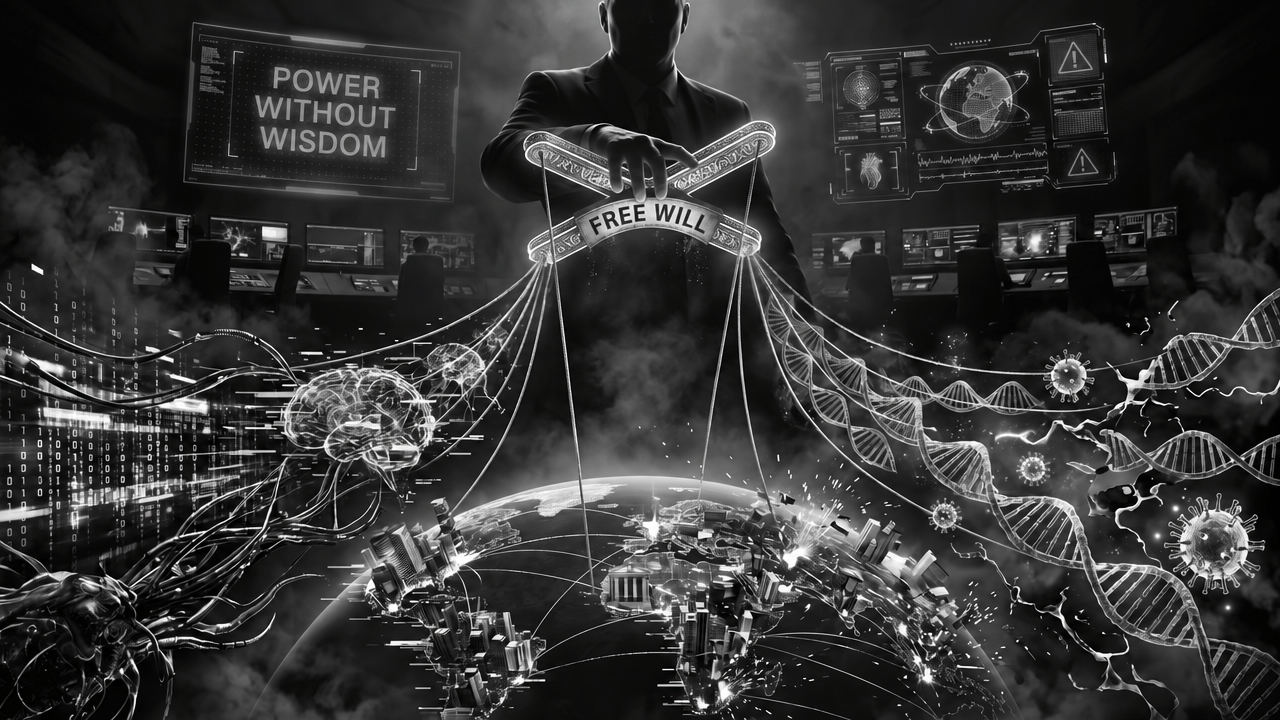
Artificial intelligence illustrates this distinction particularly well. AI represents another technological capability, much as the internet did when it first became available. The internet did not automatically produce greater human integration. It became a communication infrastructure that could be used for education, cooperation, entertainment, commercial purposes, or manipulation.
AI may follow the same trajectory. Technology provides capabilities. Human motivation determines how those capabilities are used.
The central issue is therefore not how intelligent humanity becomes, but the quality of the decisions made with that intelligence.
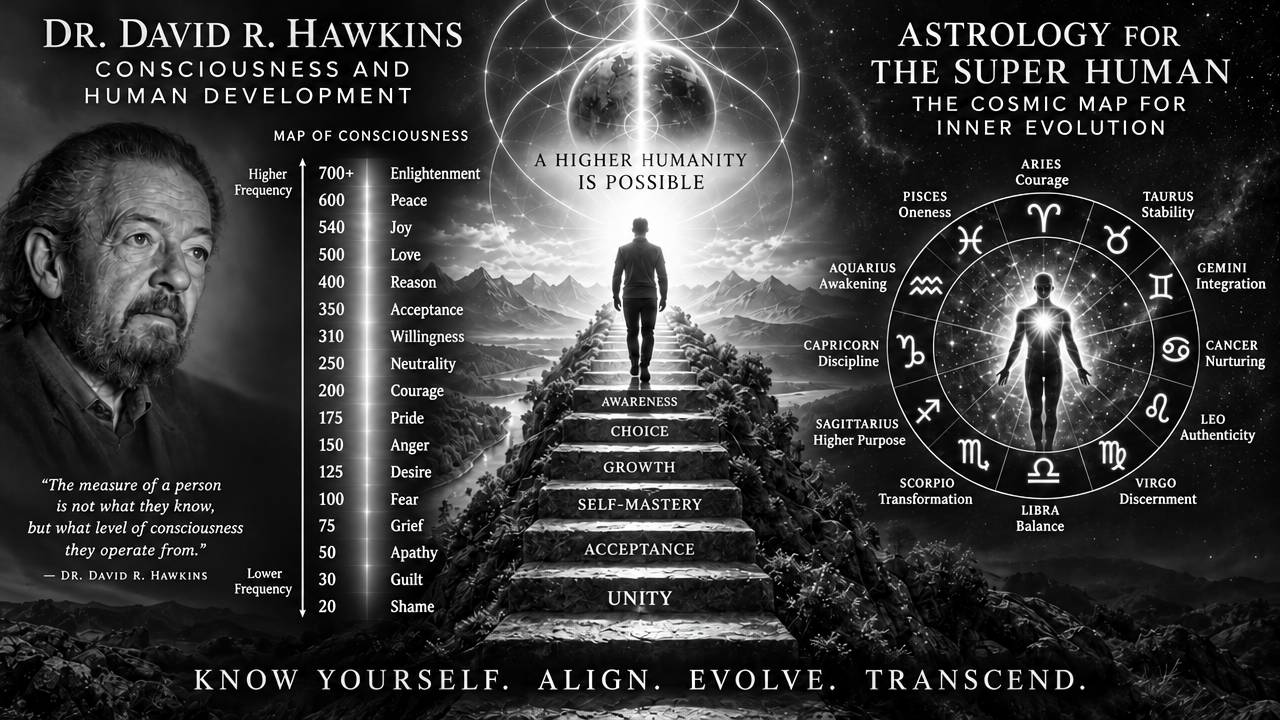
6. Ego and Consciousness: Two Different Directions
A useful framework for understanding human development is the relationship between ego and consciousness.
The proposed model is:
Consciousness = Awareness × Integration with the Whole
Ego is necessary for biological survival. It allows individuals to protect themselves, respond to threats, and maintain their identity within their environment. The problem is not the existence of ego. The problem arises when survival-oriented thinking continues to dominate after immediate survival is no longer the primary concern.
Consider the progression:
1. Personal survival: My immediate needs come first.
2. Family and group: My identity expands to include those who belong to me.
3. Humanity: I recognize that my responsibilities extend beyond my immediate group.
4. Existence: I recognize my relationship with the larger system.
The corresponding ego-driven orientation operates in the opposite direction. A person may care deeply about family while remaining indifferent to people outside that circle. Another may identify strongly with a country, religion, or political group while considering people with different affiliations as enemies.
The important distinction is that consciousness development involves expanding the boundaries of what an individual considers part of their responsibility. This is not the elimination of individuality. It is an expansion of perspective.
7. Survival Mode and the Difficulty of Consciousness Development
People experiencing hardship often have difficulty moving beyond survival-oriented thinking. When someone is concerned about food, shelter, safety, or protecting their family, their attention naturally concentrates on immediate needs. This is not a personal failure. It is a consequence of circumstances.
However, survival is not exclusively biological. It can also be psychological and social.
People with relatively comfortable material circumstances can remain trapped in defensive behavior because their identity depends on belonging to a particular group. Political affiliation, religion, nationality, social status, and professional identity can all become sources of perceived threats.
Whenever these identities are challenged, defensive reactions can dominate. Consequently, a person may have sufficient material resources to explore broader questions of existence but remain psychologically attached to survival-oriented patterns. This creates an important challenge: unless social conditions allow individuals to move beyond constant survival concerns, consciousness development becomes considerably more difficult.
8. Social Media and the Loss of Individual Purpose
Modern social media introduces another dimension. People are continuously exposed to images of supposedly successful lives, wealth, recognition, and personal achievement. The problem is not entertainment itself. It is the possibility of replacing personal development with the imitation of someone else’s experience.
The process can be described simply:
1. An individual develops an idea of what success should look like.
2. Social media provides thousands of examples.
3. Comparison becomes a regular activity.
4. External validation becomes increasingly important.
5. Personal objectives become influenced by someone else’s standards.
The individual may spend years trying to reproduce a life that was never their own objective. Admiring another person’s accomplishments is not necessarily problematic. The problem begins when admiration replaces self-discovery.
You cannot discover your purpose by living someone else’s experience.
9. Each Person Is an Independent Universe
Each human being is an independent center of experience, interacting with the rest of existence. Parents, teachers, books, friends, and institutions can provide knowledge and introduce possibilities. But they cannot perform another person’s consciousness development. You can share information, but you cannot force someone to integrate it. You can demonstrate cooperation, but you cannot impose genuine cooperation. You can explain purpose, but you cannot give someone their own purpose.
This is particularly relevant to Campbell’s emphasis on free will.
If consciousness evolves through individual choices, then the responsibility for development ultimately belongs to the individual. Self-knowledge becomes the starting point.
Before attempting to understand the larger system, one must recognize one’s own motivations, limitations, fears, and patterns of behavior. There is an important difference between self-centeredness and self-knowledge. Self-centeredness makes everything revolve around the individual. Self-knowledge allows the individual to understand themselves and eventually move beyond the limitations of their own ego.
You have to discover who you are before you can understand how you relate to everything else.
10. Purpose Is More Important Than Achievement
There is nothing inherently wrong with wealth, professional success, or building a business. The distinction is the motivation behind the activity. Two individuals can achieve identical financial results while operating from entirely different levels of consciousness. One may be motivated primarily by power, recognition, and personal accumulation. Another may be motivated by creating something valuable, contributing to society, and providing opportunities for others.
The external accomplishment may be similar, but the underlying intentions are different.
This is consistent with Campbell’s proposition that the quality of consciousness is reflected in the intent behind decisions. External achievements do not necessarily indicate consciousness development. A person can accumulate enormous wealth while remaining highly self-centered. Another can live modestly while demonstrating extraordinary concern for others.
The question is not simply what someone accomplishes, but why and how they accomplish it.
11. The Individual Contribution to the Larger System
If we assume that individual consciousnesses participate in a larger consciousness system, then personal development potentially changes the quality of the information contributed to that system. An individual moving beyond ego-driven decisions begins to consider consequences beyond immediate personal interests. Cooperation becomes more natural. External validation becomes less important. The individual recognizes that other components of the system have independent experiences and deserve consideration.
In Campbell’s terminology, this can be interpreted as a movement toward lower entropy.
Whether individual development translates into measurable changes in the entropy of a planetary or universal consciousness system remains an open theoretical question. Nevertheless, the possibility provides an interesting way to connect individual development with collective evolution.
Perhaps the purpose of an individual is not simply to survive, accumulate, or become successful, but to develop the capacity to participate consciously in something much larger than themselves.
12. Sharing Ideas Without Seeking Recognition
An interesting practical example of this philosophy is the exchange of ideas through writing. For ten years, articles about astrology, self-development, and consciousness have been published online with the objective of sharing a particular perspective. Readers from approximately 70 countries have accessed these articles, primarily through search engines, but also through redistribution on social media and other websites. The number of likes and comments has been very small. However, the absence of visible interaction does not necessarily indicate an absence of impact.
Some readers may simply be looking for information. Others may reflect on an idea without participating publicly. Some may share an article without knowing its original author. This introduces an interesting distinction between having an audience and having followers. An audience can consume ideas without identifying directly with the person communicating with them.
The purpose of sharing knowledge does not necessarily require personal recognition.
If an article makes someone question an assumption, reconsider a decision, or explore a new perspective, it has potentially accomplished something meaningful. The message can travel independently of the messenger.
Conclusion: From Individual Consciousness to Collective Evolution
The ideas explored here lead to a central possibility.
Human existence may be part of a much larger system in which individual experiences contribute to the evolution of consciousness. Within this perspective, technological progress, material achievement, and social recognition are not necessarily indicators of evolutionary development. The more fundamental question concerns the quality of individual choices and the extent to which awareness expands beyond personal interests. The progression from personal survival to family, community, humanity, and ultimately existence represents an expansion of the individual’s understanding of interconnectedness. This does not require abandoning individuality, rejecting material achievement, or adopting a particular ideology.
It requires understanding oneself, recognizing the limitations of ego-driven behavior, and consciously choosing how to interact with the rest of existence.
Perhaps the next evolutionary step for humanity is not primarily technological. Perhaps it is the transition from living exclusively as individuals concerned with their own survival to becoming conscious participants in a much larger system.
The purpose is not necessarily to become something greater than others. It may be to understand that we have always been part of something greater than ourselves.

Leave a Reply