
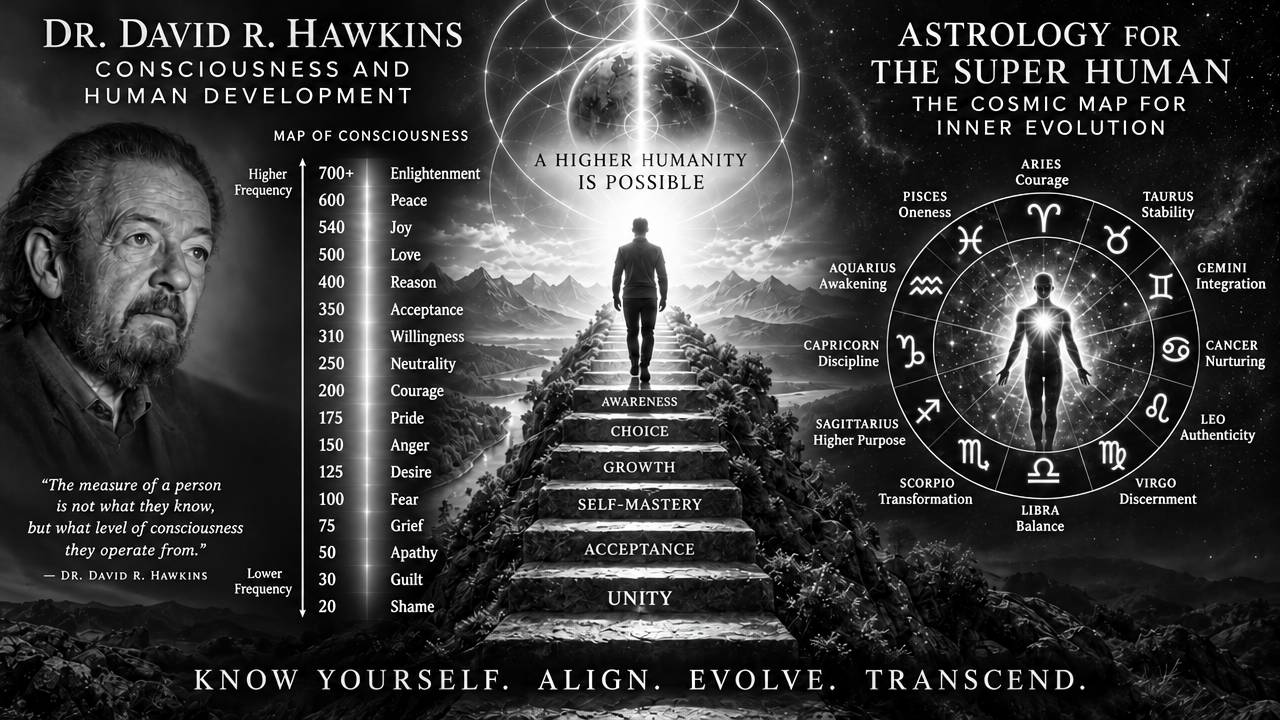
Dr. David R. Hawkins and “Astrology for the Super Human”
The Natal Chart describes the circumstances. The level of awareness describes the stance from which they are met. This post explores that parallel, even if Hawkins did not build his map from astrology.
Saturn, in the tradition we work with, is restriction, responsibility, limitation, fear, and the obstacle that does not move because we would prefer it to. The same symbolism can be lived in at least three ways.
From fear, Saturn is punishment. The door is locked, the deadline is a verdict, and the person who carries the chart is the one who has failed.
From courage and acceptance, the same Saturn is discipline. The limit is real. Meeting it is how responsibility and maturity are built.
From a wider awareness, Saturn is instruction. It shows the shape of a cycle, the cost of a promise, and the kind of mastery that exists only inside a constraint.
The planet has not changed. What changes is a person’s relationship to the symbolism, and to the circumstances that come with it. David R. Hawkins never said this about Saturn. He was not constructing an astrology. The example is ours. It is the move “Astrology for the Super Human” asks of a chart: not a forecast of what will happen, but a clearer account of the awareness from which it will be met.
Hawkins (1927–2012), a psychiatrist and the author of *Power vs. Force* (1995), described human development as a movement through levels of awareness. We come to a related shape from astrology and from the older traditions that practice sits among. The two descriptions are parallels, not a single system discovered twice.
By “Super Human” we do not mean a higher species, or a person who has floated free of a chart. We mean someone who can meet the same chart from a wider awareness than fear, pride, or the need to control. The chart remains. The stance changes.
We have written about neighboring questions in “Astrology for the 21st Century” and in “The Game of Life”. Here the question is narrower.
Hawkins proposed a logarithmic scale from 1 to 1,000, with emotional and spiritual states set along it. The landmarks that matter for this essay are few. Below the line he draws at 200 sit shame, guilt, apathy, grief, fear, desire, anger, and pride. At 200 he places courage, and he calls that crossing a shift from force to power. Above it comes neutrality, willingness, acceptance, and reason, then love, joy, and peace, and, toward the top of the scale, the non-dual awareness he calls enlightenment.
The proposition worth keeping is not the numbering. People do not merely feel different emotions. They interpret the same world from the level at which they are operating. In fear, a street is a place of danger. In courage, it is a set of possibilities and difficulties. In love, other people are less useful and more real. In peace, the hard line between the one who sees, and the thing seen begins to give way. The street did not change.
He arrived at the numbers by applied kinesiology, or muscle testing. A statement was made, and the resistance of an extended arm was read as true or false, higher or lower. He reported that he and his collaborators had made hundreds of thousands of such calibrations, of emotions, concepts, books, people, and institutions. The method is disputed. The scale is not a scientific instrument. We are not asking anyone to accept a score of 200, or a score for a planet, an aspect, or a person.
What we take from the map is the gradient. The same event can be lived from very different places, and those places are not the same thing as being clever. Below the threshold he marks, force tends to generate counter-force: blame, self-defense, a hunger for outside verdicts, reaction, control, competition. Above it, the pull is different: responsibility, a look at oneself, a quieter confidence, a chosen response, understanding, cooperation. In coaching we care about that change of stance. We do not care about the number that happened to be written beside it.
One confusion should be cleared before anyone tries to attach it to a chart. Hawkins often speaks of energy, frequency, and level. His fullest treatment is in “Discovery of the Presence of God”. The word “vibration” is asked, in this neighborhood, to carry three different meanings.
• Physical vibration. An oscillation that can be measured: a sound wave, an electromagnetic wave, a molecular movement.
• Biological activity. The nervous system signaling electrically and chemically. An EEG can record patterns of that activity. Those patterns are not a number for consciousness.
• Spiritual or metaphorical vibration. The language in which traditions have pointed at states of awareness: prana, qi, pneuma, and the Hermetic habit of speaking as if consciousness were a rate of oscillation.
A chart is not a frequency reading. A level of awareness is not a laboratory result that happens to share a word with one.
Hawkins drew openly on contemplative teachers, among them Ramana Maharshi, and on Christian mysticism. What follows is a reading, not a one-to-one correspondence, and not a claim that his scale rediscovers these traditions in scientific dress.
Advaita Vedanta holds that the individual self, Atman, and ultimate reality, Brahman, are not two. Ordinary life is organized by a smaller identification: the body, the personality, the stream of thoughts and desires, the story of being a particular someone. Practice, on this account, does not build a better someone. It is the recognition that the smaller identification was never the whole.
Set beside the map, the stages rhyme up to a point.
Hawkins Advaita
- • Pride and ego Identification with the limited self
• Acceptance The beginning of surrender
• Love Recognition of unity
• Peace Loosening of the mind’s claim to be the knower
• Enlightenment Realization of non-duality
The rhyme is useful. The difference is more useful.
Advaita does not describe enlightenment as a ladder of increasingly refined emotions. It describes seeing what was already the case and hidden by ignorance. On this view, consciousness does not become something else. It becomes aware of what it is.
The book does use a gradient, because a chart has to be usable in an ordinary week. Someone in the middle of a hard Saturn period is not helped by being told only that, from the widest point of view, the fear was never ultimate. The gradient gives a direction: from reaction, toward responsibility, toward a wider way of holding the same fact. We want Advaita’s caution in the same hand. “Super human,” in the title, is not a superior identity to climb into and then defend. Fear, self-defense, and the need to be the one who knows are not the whole of the person who has the chart. Practice is there so that this can be lived, not merely agreed with.
Other traditions come to a related insight by other routes, and it’s hard to include them in a single post. Buddhism connects suffering with attachment, aversion, and ignorance, and it trains a person to see those processes rather than to suppress them. That sits close to the lower stretch of Hawkins’s map, where fear defends, desire clings, anger resists, and pride mistakes the ego for the self. In Plotinus, reality proceeds from the One, and spiritual development is a turning back from the many toward that unity. He is describing degrees of being. Hawkins is describing states of awareness. What they share is the direction of travel. Hermetic writing says, in its own vocabulary, that mind and world are not strangers. The line people usually quote, “All is Mind; the Universe is Mental,” is from “The Kybalion”, a modern work, and it should not be asked to stand in for the older “Corpus Hermeticum”. The point that survives that caution is the point Saturn has already made. An event can be lived as a threat, an injustice, an opportunity, a lesson, or a fact inside a larger order. The event stays. The meaning moves.
In our own teaching we use a further picture. It is not Hawkins’s scale, and it is not a research finding. It is a way of noticing what a person is acting for.
The circles run outward, from one’s own survival to existence itself. Read in the direction of consciousness, wider is further along. Read in the direction of ego, the same sequence runs backward: the ego has most to defend where the world has shrunk to one’s own survival, and least where concern reaches existence itself.
Consciousness Driven
- • Lowest – Only me, my survival
• Basic – Me and my family
• Intermediate – My tribe, country, company
• Higher – Humanity as a whole
• Highest – Earth, solar system, existence itself
EGO Driven
- • Highest – Only my survival
• Higher – Me and my family
• Intermediate – My tribe, country, company
• Basic – Humanity as a whole
• Lowest – Earth, solar system, existence itself
This is a model of development, not a sorting of humanity into two types. It does imply something that is easy to miss, and that matters more as technical ability grows. Development here is not an accumulation of knowledge. Someone can be extraordinarily intelligent and still be run by fear, pride, or the need to control. Someone with little formal education can be precise in compassion. Intellectual development and the development of awareness are different projects. A clever reading of a chart is not the same thing as a conscious one.
Knowing is not the same as being able. Hawkins is strict about this, and work with a chart runs into it at once. Understanding what unconditional love means is not the experience of it. Understanding forgiveness is not the ability to forgive. A person can give a correct account of a Saturn placement and still flinch in the old way when the transit arrives.
We picture the gap, as an illustration of our own and not as his model, in three stages.
- • Intellectual awareness. The concept is understood.
• Experiential awareness. It is being applied, unevenly, in the week one actually has.
• Integrated awareness. It has become the ordinary way of seeing and acting, and no longer needs a performance of insight.
The priority of practice over concept is old. A map, his or ours, is not yet a practice. Hawkins offered a practice in ‘Letting Go’, the method of surrender, and not only a classification. The last chapter of “Astrology for the Super Human”, Astrological Coaching, is where we introduce how to understand a chart, and how to apply it to a life rather than to a commentary.
This pursuit of evolution is exactly what the book is for.
From Dane Rudhyar onward, and in the work of Liz Greene and Stephen Arroyo among others, psychological astrology has treated the chart as a map of growth rather than as fate. We do not claim to have invented that.
What has been less fully developed is a systematic description of how the same configuration is lived at different stages of awareness, and a practical process for moving from one stage to another. Hawkins’s map does something analogous for emotion and perception. It does not replace the experience. It describes a gradient in how the experience is lived. The book applies that kind of gradient to the chart. The Saturn example at the start is the pattern in miniature. The planet is held steady. The stance is allowed to change.
The Natal Chart is a point of origin: a symbolic picture of pressures, resources, and tendencies, not a sentence passed in advance. Used this way, astrology is a means of raising awareness, first by seeing that point of origin clearly, then by meeting a planetary aspect with some choice in the matter. It goes further than our earlier books into consciousness, into the way a pattern is carried in a life and a body, and into the traditions just set beside Hawkins. Those are there to serve one question.
The question needs a purpose, and the purpose is concrete. It is the intention you bring to an aspect or a transit: why you are looking at this configuration now, rather than a wish to be told the future. The aim is to understand the energies in play and to meet them consciously.
“The Game of Life” tells the same idea as a story. Celeste moves through her cycles and her purposes, and what happens is the way she meets what her chart brings forward.
The coaching chapter is where we start the process. That’s why we offer classes in our online-school and you can check the details of the first semester @ https://thenewroads.online/
Whatever one decides about the way Hawkins measured, the map points at something that holds up without the measurements. The same circumstances can be lived very differently, according to the awareness brought to them. The contemplative traditions reached a similar insight by other routes. A Natal Chart can be read in that light.
The chart describes the circumstances. The level of awareness describes the stance from which they are met. The coaching process in the last chapter of *Astrology for the Super Human* is our attempt to make that distinction usable.



Leave a Reply