
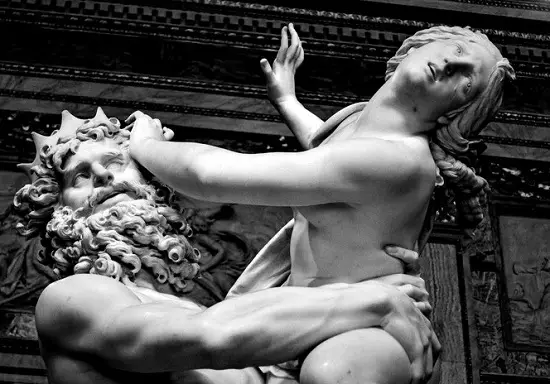
The Abduction of Persephone: Pluto in Love
According to mythology, Pluto used a helmet that made him invisible when he left the underworld. He represents, therefore, a force that operates below the surface level of consciousness, a facet of our psyche that unconsciously attracts situations that cause us to break down so we can reconstruct ourselves in a different way. Pluto only ascended to our world on two occasions, once to heal a wound, and the second to abduct Persephone. Pluto’s transits are often experienced with the utmost clarity in issues related to health and relationships. We encounter Pluto in illness, when toxins and poisons are drawn to the surface and eliminated from the body so that the organism can function well again. We also come across the god of the underworld in relationships when emotional complexes surface and become exposed. Pluto’s Transits can bring new relationships or create tensions in existing ones intended to mobilize and reactivate what is buried within us. Again, we can refer to the myth to expand and deepen what we know about Pluto’s effects in this realm of life.
In spring, we find the maiden Persephone playing in a field with other virgin goddesses, happy and content in the protective embrace of her mother, Demeter (Ceres), the goddess of the Earth. Persephone is young and inexperienced, living peacefully in the upper world, on Earth, at the surface level of life, but Aphrodite, the goddess of sensual love, sees her from Olympus and finds her incredibly naive and innocent.
As a balancer of imbalances, Aphrodite decides to teach Persephone a lesson and orders Eros to wound Pluto with a love arrow, who is nearby. Unknowingly, Persephone picks a narcissus, a flower associated with the underworld. The Earth opens, and Pluto emerges from it, in his black chariot drawn by four fire-breathing horses. Pluto seizes Persephone, takes her to the underworld, and there, he violates her. In the blink of an eye, Persephone is torn away from the spring meadow of a cheerful and sunny world and now finds herself in a dark and mysterious place, a site of passion, sexuality, and intense emotions. After this, the name takes the meaning “she who loves the dark.”
Initiated by Pluto into womanhood, she is no longer a maiden. At least symbolically, she has freed herself from her mother’s domination and is now a woman in her own right. Demeter (Ceres), anguished by the loss of her only daughter, falls into a deep depression and forbids the growth of cereals and the fruiting of trees.
For seven years, the entire world grows cold and barren, and humanity starves. Finally, the gods, concerned that there will be no one left to worship them, intercede and manage to allow Persephone to reunite with her mother. Since Persephone has tasted the pomegranates of the underworld (a symbolic way of saying her blood has been shed and she has lost her virginity), she is allowed to return to the earthly world only for six months a year. The remaining months she must spend with her husband, Pluto, in her role as queen of the underworld.
To the Greeks, this myth served as an explanation of how the seasons came into existence. Before Kore’s abduction, spring and summer were eternal; but now, each time Persephone must separate from her mother to return to the underworld, Demeter mourns: the trees shed their leaves, the crops disappear, and winter arrives.
The myth refers to a passage, a rite of initiation: the adolescent must depart from the womb of the family or ancestors to become a person in their own right. But no matter how old we are, the myth also describes what happens when we commit ourselves to a relationship of passionate intimacy. Like Persephone, through love, we find ourselves submerged into the underworld where we confront our hidden emotional complexes. Intimacy lays bare the secret inner world of the child that remains alive and kicking in our unconscious: a world of passion, rage, envy, greed, lust, and jealousy.
Perhaps at some point, our partner cannot give us precisely what we want or need, and inside us, the jealous child resurfaces, fearful of abandonment and death. Sometimes we feel capable of harming our loved ones, while other times we want to destroy or ruin a relationship because we cannot accept the power the other person has to make us feel sad or happy, fulfilled or unfulfilled. Intimacy stirs all these emotions in us.
Far from what we learned that love provides a joyful state of mind!
Finally, Persephone becomes the lady of two worlds. She feels comfortable in the upper world, living on the surface of life. She is capable of being light, natural, joyful, and innocent, and of talking about trivial matters. But she is also familiar with the underworld: she has connected with the darker emotions in her.

Leave a Reply