
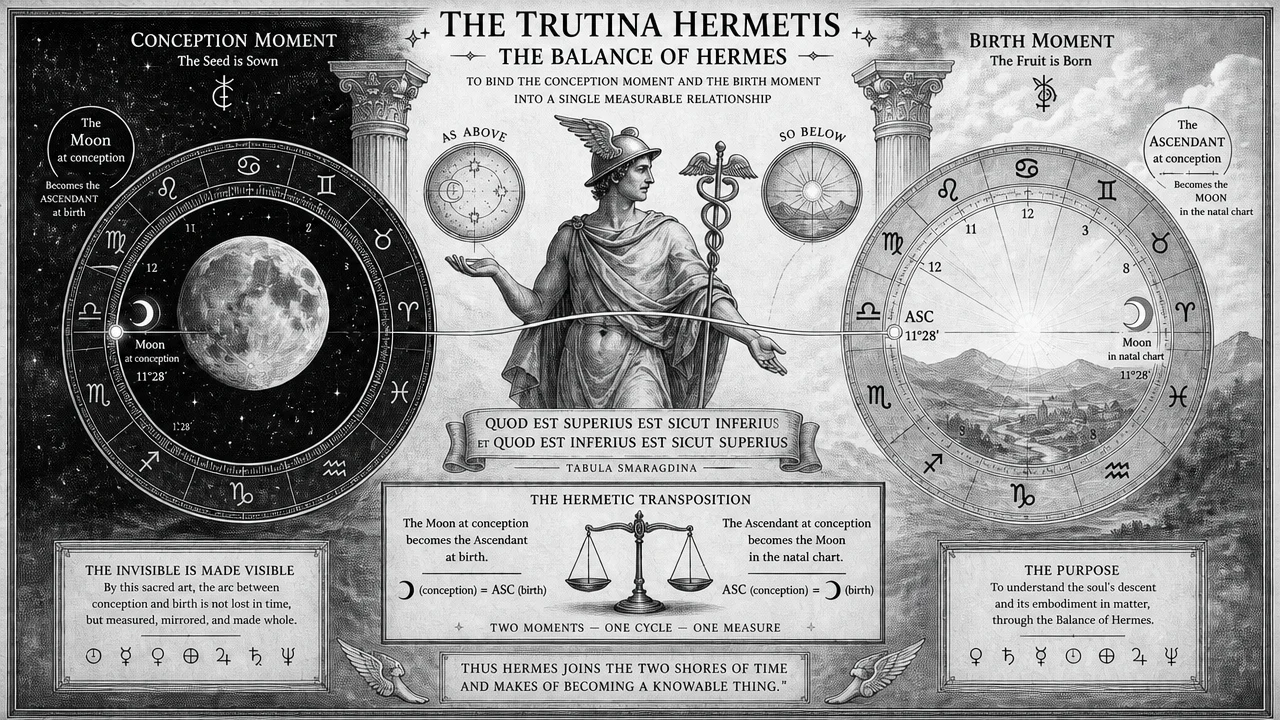
The Trutina Hermetis
We are sharing some material that forms part of our first semester at TheNewRoads.online.
Besides discussing in our classes the scientific methodology and the mechanics of how astrology works, we also study the historical record, in order to understand where the knowledge we use actually came from.
The Trutina Hermetis traces its origins to ancient Hellenistic Egypt and is traditionally attributed to Hermes Trismegistus, a legendary syncretic figure associated with the Egyptian god of wisdom, Thoth.
The rule appears in the Centiloquy (a collection of 100 astrological aphorisms). While historically wrongly attributed to the great astronomer Ptolemy, scholars now believe this text was authored in the 10th century by the Arabic astrologer Abu Ja’far Ahmad ibn Yusuf.
The 12th-century Jewish scholar Abraham Ibn Ezra played a massive role in transmitting the technique to Hebrew and Latin readers. He referred to the method as mo’znei Hanok (“Enoch’s balance”) and used it to calculate his own gestation period.
The Trutina Hermetis (Latin for the “Balance of Hermes” is an astrological technique used primarily for rectification, the process of mathematically determining or correcting a person’s exact time of birth when the recorded time is unknown or uncertain. The original version is attributed as we mentioned, to Hermes Trismegistos.
The technique is based on a reciprocal relationship between the heavens at the time of physical conception and the heavens at the time of birth.
The fundamental rule asserts that the zodiacal degree of the Moon at the moment of birth is the exact degree of the Ascendant (or Descendant) at the moment of conception.
Conversely, the degree of the Moon at the moment of conception is the exact degree of the Ascendant (or Descendant) at the moment of birth.
Because the Moon is the natural astrological significator of women, fertility, and pregnancy, the Trutina Hermetis relies on lunar motion to bridge the gap between gestation and birth.
The technique remained a staple of traditional astrology for centuries and was utilized and written about by prominent figures like the 17th-century English astrologer William Lilly.
We mention William Lilly (1602–1681) because it was arguably the most famous and influential astrologer in 17th-century England. His career peaked during the tumultuous English Civil War, where his astrological practice became heavily intertwined with national politics, military intelligence, and the daily lives of the English public.
He standardized and democratized the practice by publishing the book Christian Astrology in 1647. It was the first comprehensive astrological textbook written in English rather than Latin, making the rules of traditional astrology accessible to the educated public. He also published highly popular annual almanacs that offered political and weather predictions, providing him with high visibility and social status.
Lilly’s consulting covered a diverse cross-section of society from Citizens, Parliamentary Leaders, military commanders, political figures and King Charles I, regarding strategic timing, battle outcomes, and military intelligence and natal charts.
In his seminal 1647 textbook, Christian Astrology, he demonstrates the technique by rectifying the chart of an “English Merchant”.
Lilly used the traditional square chart format to map out his calculations.
Here is the step-by-step mathematical procedure he used to correct the merchant’s time of birth.
1. Establish the Unrectified Data: September 19, 1616.
First, Lilly cast a chart for the merchant’s estimated time of birth.
Estimated Ascendant: 6° Capricorn
Natal Moon Position: 1°40′ Gemini (located in the 5th house)
Because the Moon was in the 5th house, it was below the horizon. According to the rules of the Trutine, this meant the native’s gestation period was longer than the standard 273 days. The sidereal lunar month is 27.32 days. Ten sidereal lunar months is 273.2 days.
2. Calculate the Lunar Distance:
Lilly needed to find the exact distance between the estimated Ascendant and the Moon.
From 6° Capricorn to 1° Gemini is 145 degrees (or 4 full zodiac signs plus 25 degrees).
3. Adjust the Gestation Period: 1 day for every 12 degrees.
The Trutine assigns 1 day of gestation for every 12 degrees of distance between the Ascendant and the Moon.
145 degrees ÷ 12 = roughly 12 days.
Because the Moon was below the horizon, Lilly added these 12 days to the baseline 273-day gestation period.
273 + 12 = 285 days of pregnancy.
4. Determine the Conception Date:
Lilly then counted backward 285 days from the birth date of September 19, 1616.
1616 was a leap year, making September 19 the 263th day of the year.
Subtracting 285 days from day 263 pushed the date back 22 days into the previous year (December 1615) December has 31 days. Counting backward 22 days from the end of the month gave a conception date of December 9, 1615.
5. Cast the Conception Chart: The Rule of Hermes.
Applying the core rule of the Trutina Hermetis, Lilly took the exact degree of the Moon at birth (1°40′ Gemini) and made it the Ascendant of the conception chart for December 9, 1615.
6. Find the Rectified Ascendant:
Lilly then consulted his ephemeris (a table of planetary positions) to see exactly where the Moon was located on December 9, 1615, at the moment 1°40′ Gemini was rising on the eastern horizon.
He found the conception Moon was at 0°20′ Capricorn.
Therefore, by the reciprocal rule of the Trutina Hermetis, 0°20′ Capricorn was the true, rectified Ascendant of the merchant’s birth chart, shifting it backward a few degrees from the original estimate of 6° Capricorn.
Once Lilly established 0°20′ Capricorn as the exact rising degree, he could adjust the merchant’s time of birth accordingly and recalculate the rest of the house cusps with precision, allowing for far more accurate forecasting.
The premise beneath the Trutine , that information present at conception remains legible in the chart of birth nine months later, is now testable in ways Hermes could not have imagined.
In a recent Master Class, we examined a case in which DNA analysis showed markers for a disorder of the digestive process affecting mood and behavior, while the same person’s natal chart showed aspects pointing to a comparable congenital predisposition. The genome was fixed at conception; the chart was cast for a moment some nine months later.
What the case does is point at exactly the continuity the technique assumes , that the two moments are informationally linked, and that is reason to investigate the method seriously rather than dismiss it.
That investigation is the work we take up in the classroom, and it is the standard we hold ourselves to an ancient technique is worth studying not because it is old, but because it makes claims specific enough to be examined.




Leave a Reply