
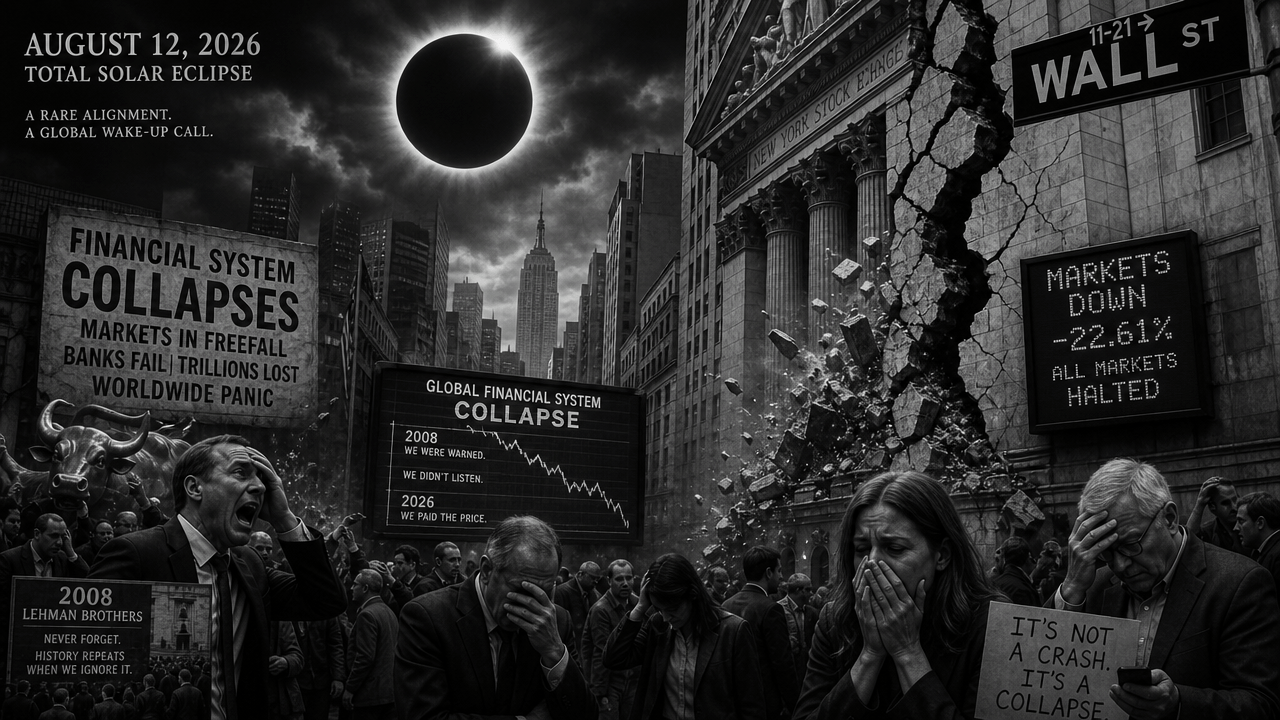
SOLAR ECLIPSE AUGUST 12, 2026 – FINANCIAL IMPLICATIONS
First, a quick introduction so people not familiar with astrology could understand under what concepts and logic we do our analysis, and what proof we have for being on target in the past.
That astrology functions based on cycles. When we hear humans are the only ones to trip twice on the same stone, what’s the meaning of that? Simple is saying we make the same mistake presented with the same situation more than once. That clearly establishes that we go over similar situations in our life (cycles) and if we don’t learn, we are open to repeat the mistake.
We changed, the environment changed but our reaction to any similar situation could be the same. Similar happens with countries and the world. At the end is individual people that create structures and these structures go through cycles.
Astrology only provides the information, what we do with that information is up to each one of us.
When we mention that we already have proofing track on anticipating global events, we have to go back to 2019-2020 period. Because of the lunar eclipse of January 10th, 2020, we forecasted in September 2019 a global institutional crisis for 2020. Which happens.
After further research, we found similar astrological aspects to 1918. Based on that, we anticipated on January 27th, 2020, that there was a big possibility of a pandemic. Three months later, in March 2020 it was declared.
It did not stop there, we followed the trend of the pandemic and through different articles during 2020 and 2021 we clearly mark the cycle of the virus, new variants and the problem with the so-called vaccines. For that reason, our blog was “penalized” and disappear from Google search even if at that time we had an audience from 72 countries.
The original articles are still available in the blog and in 2021 we published a small Kindle book available on Amazon which includes the articles published in the blog for the period mentioned.
On July 7th, 2026 we published an article called Financial Reset in Progress for the US.
https://elnuevocamino.com/2026/07/07/financial-reset-in-process-for-the-us/
On July 21st, 2026 we published The End of a Cycle
https://elnuevocamino.com/2026/07/21/the-end-of-a-cycle/
The August 12, 2026, total solar eclipse belongs to Saros series 126, and the previous member of that same family was the eclipse of August 1st, 2008, before July 22nd, 1990, and before that July 10th, 1972.
It’s not only the eclipse (which on its own should be enough), but the aspects that Saturn and Neptune triggered in February 2026. Coincidently that happened few days after the war with Iran started. Take note of that.
The previous time same aspect happened between Saturn and Neptune at 0 degree of Aries, it was over six thousand years ago, so there is no information that we can use to compare.
Historically Saturn and Aries correlate with the dissolution of structures that people assumed were permanent. Saturn is the structure; Neptune dissolves it. This time around is different because Aries signals new beginnings. Neptunian structure on Earth right now is fiat currency itself, which runs entirely on collective belief. In addition to the solar eclipse the energy generated by Saturn–Neptune could trigger the payment layer dissolving now (visible), the pricing layer contested next (the actual battleground), and the unit-of-account layer, the collective agreement about what value “is”, holding until a crisis moment resolves it. Neptune dissolves belief from the outside in, and Saturn restructures organizations from the inside.
We provide a quick summary of the current situation that can affect the financial conditions as well as what happened with previous a solar eclipse of the same Saros Series mentioned.
August 12, 2026 (Eclipse will happen)
Active Armed conflicts
• US – Iran
• Israel – Lebanon
• Israel – Iran
• Yemen’s Houthi – South Arabia
• Russia – Ukraine
Current general conditions
• Stagflation Pressures and Federal Reserve. Monetary Policy Conflict: If employment cools down, the Fed faces pressure to cut interest rates, but doing too much too soon risks reigniting inflation.
• Sweeping Trade Tariffs and Consumer Costs. Broad tariff regimes and retaliatory trade measures can disrupt global supply chains and increase costs for businesses that rely on foreign inputs. Increase of cost of Living.
• National Debt: The U.S. national debt and mounting annual budget deficits limit the government’s fiscal flexibility.
• Labor Market Shifts and Affordability: Consumer Vulnerability, persistent inflation in housing, healthcare, and utility costs could leave everyday consumers more financially vulnerable to micro-shocks.
• Technology Disruption and Market Valuations AI Bubble Concerns: Massive capital expenditures are flowing into artificial intelligence infrastructure and tech firms. A disconnect between heavy spending and actualized short-term corporate revenue could trigger market corrections.
For example, here is an estimation how long companies within the Magnificent Seven can continue to operate at normal level with a big hit on revenue
• Tesla ~41 Months
• Alphabet ~23 Months
• Meta ~10 Months
• Nvidia ~8 Months
August 1st, 2008 – Global Financial Crisis
Main Financial News
• Lehman Brothers collapsed on September 15th, a little over a month after the eclipse.
• Fannie Mae and Freddie Mac Conservatorship (September 2008)
• AIG Rescue (September 2008):
The Collapse and Fire Sales of Other Wall Street Institutions
• Merrill Lynch Sale (September 2008)
• Washington Mutual Collapse (September 2008)
Record-Breaking Commodity Spikes and Volatility
• Oil’s Wild Ride: In July 2008, crude oil prices hit an all-time record high, peaking at $147.50 per barrel amid surging global demand (especially from China) and heavy speculation. However, as the global recession set in later that year, oil prices plummeted drastically, tumbling below $40 by December.
Global Banking and Sovereign Debt Tremors
• The Icelandic Financial Collapse (October 2008): Iceland’s three major commercial banks (Landsbanki, Kaupthing, and Glitnir) completely collapsed
• European Banking Shocks: Countries across Europe faced major bank rescues. In the UK, Northern Rock had already been nationalized earlier in the year, and governments across Europe had to rush emergency guarantees to backstop their own domestic banking sectors.
Legislative and Monetary Responses
• Emergency Interest Rate Cuts: Throughout 2008, the U.S. Federal Reserve and global central banks aggressively slashed interest rates, eventually bringing rates down near zero and inventing unconventional “quantitative easing” liquidity facilities.
•
The TARP Legislation (October 2008)
After initial legislative pushback, the U.S. Congress passed the Emergency Economic Stabilization Act, establishing the Troubled Asset Relief Program (TARP), which initially authorized the U.S. Treasury to inject $700 billion directly into struggling financial institutions.
1990 – The Beginning of the Recession Official Start (July 1990)
The U.S. National Bureau of Economic Research (NBER) later dated the exact start of the early 1990s recession to July 1990, bringing a sudden halt to the long economic expansion of the 1980s.
• Iraqi Invasion of Kuwait (August 2, 1990)
• Rising Unemployment
• Oil Price Shock and the Gulf Crisis
• Crude Oil Spikes: from roughly $17 per barrel in July to a peak of over $45–$46 per barrel by October 1990.
• Spike in Inflation
Wall Street Correction and Bear Market Pressures
• Stock Market Drop:
• The Dow’s Fall: The Dow Jones Industrial Average dropped roughly 18% in a three-month span.
The Savings and Loan (S&L) Crisis Fallout
• Throughout late 1990, the financial headlines were dominated by the deepening Savings and Loan crisis, as hundreds of insolvent thrift institutions collapsed.
1972 – Inflation Skyrocketed in the US
The previous solar eclipse of the same group happened on July 10, 1972. By that time the US come out of the gold standard (end of 1971) and in 1972 inflation skyrocketed.
The information is there, what you believe or not will depend on many factors but mainly related on how you were programmed to believe.
Time will tell if we were correct in our analysis, but for what happens with the pandemic, one honestly wishes to be wrong.


Leave a Reply