
Secret Societies – 2nd part
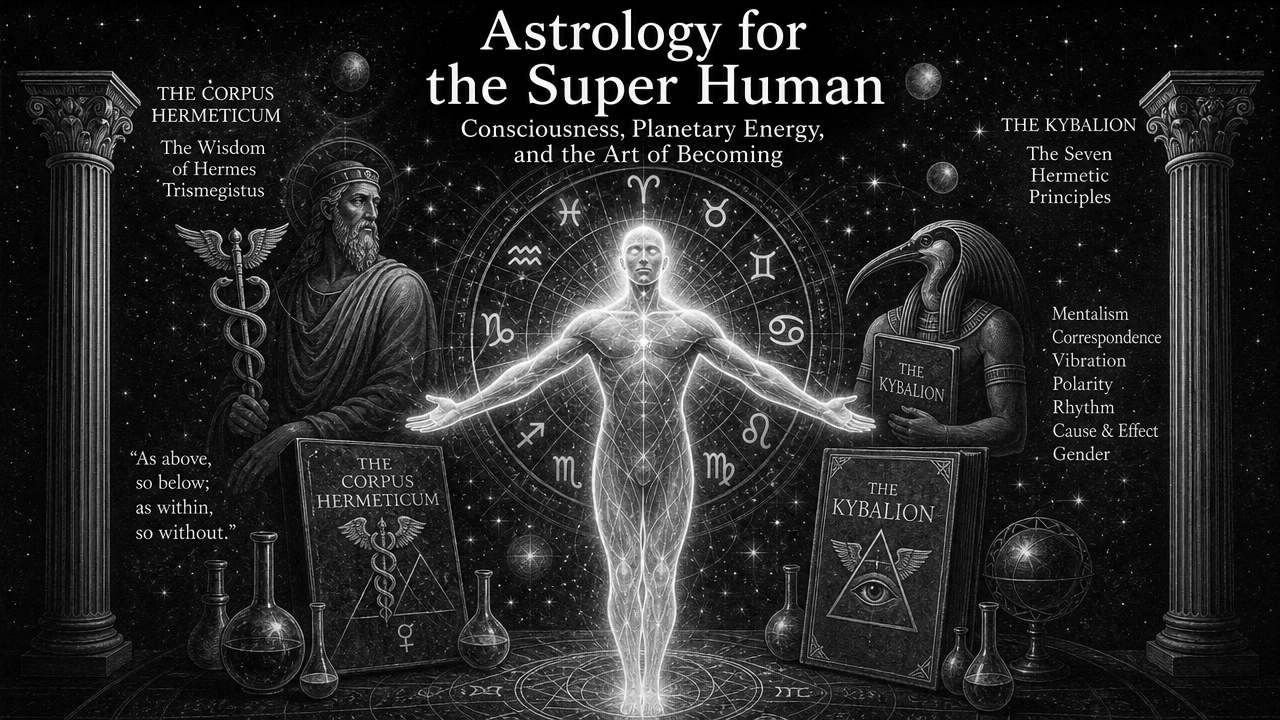
The Corpus Hermeticum, The Kybalion and Astrology for the Super Human
One Teaching, Three Eras
Two thousand years ago, in the intellectual ferment of Roman Alexandria, a group of anonymous scholars wrote down a body of teachings about God, the cosmos, and the human soul. For most of the centuries that followed, those teachings circulated quietly, copied by Byzantine monks, preserved by Islamic scholars, studied behind closed doors by alchemists, astrologers, and kings. Today that secrecy is coming to an end, and the reason why is written in the sky. This is the story of how the same knowledge has been expressed three times, in three different languages of consciousness.
The Corpus Hermeticum
The Corpus Hermeticum is a collection of seventeen Greek treatises that form the core text of Hermeticism, an ancient esoteric tradition. It explores the nature of God, the origin of the cosmos, the human soul, and how humanity can achieve spiritual transformation through spiritual knowledge, gnosis.
The treatises were written primarily between roughly 100 and 300 CE in Roman Egypt, largely around Alexandria. As far as we know, they were composed anonymously by Hellenistic scholars but attributed to Hermes Trismegistus, “Thrice-Great Hermes”, a mythical, syncretic figure who combined the Greek messenger god Hermes with Thoth, the Egyptian god of wisdom and magic. The writings reflect a blend of Greek philosophy, mainly Platonism and Stoicism, with Egyptian spirituality, alongside subtle influences from Judaism and early Christian thought.
Unlike the technical Hermetic works devoted to practical alchemy or magic, the Corpus Hermeticum served as a guide to philosophical and spiritual enlightenment, centered on the spiritual relationship between God, humanity, and the universe. God is presented as the supreme, all-encompassing Mind, Nous, from which all creation flows. Humans are viewed as dual beings: mortal in body, yet carrying an immortal, divine spark of light. Salvation, or spiritual awakening, is achieved not through blind dogma but by recognizing one’s inner divine nature and learning to look beyond the physical world.
For most of its existence, this knowledge belonged to tight-knit, discreet circles. In Greco-Roman Egypt its readers were Alexandrian scholars, Neoplatonists, early alchemists, and pagan intellectuals — seekers who combined Greek philosophy with ancient Egyptian religion and practiced inner transformation through gnosis in small, private communities of the mystery tradition.
The journey of the texts into medieval Western Europe was gradual and indirect. As the Western Roman Empire collapsed and knowledge of Greek faded in the West, the treatises were largely lost there. Byzantine scholars, however, preserved and copied them, eventually compiling the treatises into a single collection around the eleventh century. In the Islamic world, Hermes Trismegistus became identified with the prophet Idris (Enoch), and Islamic philosophers, astrologers, and alchemists integrated Hermetic philosophy deeply into Sufism and Islamic science, preserving in particular the technical writings on alchemy and astrology.
In the medieval West, almost the entire Corpus remained unknown, with one key exception: a Latin translation of a related Hermetic dialogue, the Asclepius. Early Christian writers such as Lactantius regarded Hermes as a pagan prophet who had foreseen Christianity, and this reputation helped keep interest in him alive through the long centuries of silence.
The full Greek Corpus Hermeticum arrived in Western Europe around 1460, when a monk brought a Greek manuscript from Byzantium to Cosimo de’ Medici in Florence. Cosimo famously instructed his scholar Marsilio Ficino to set aside his translation of Plato and translate Hermes first, a detail that says everything about how seriously the age took these texts. Ficino completed the Latin translation in 1463, and it was printed in 1471. Because scholars of the time mistakenly believed Hermes had lived around the era of Moses, the Corpus was received as a source of primeval wisdom — prisca theologia — and its arrival ignited a massive revival of Hermetic philosophy throughout Western Europe.
Between the fifteenth and seventeenth centuries, Hermetic influence reached its peak. It was no longer confined to certain circles; it captivated popes, kings, and the leading intellectuals of the continent. Among its readers and students, we find Paracelsus; John Dee, astrologer to Queen Elizabeth I; and even Isaac Newton, who spent decades translating Hermetic and alchemical texts. Centuries later, Carl Jung would study the Hermetic and alchemical corpus extensively, using its symbolism to map the human unconscious and the process of individuation.
1908: The Kybalion
Fast forward to 1908, and we find The Kybalion. Though published anonymously under the pseudonym “The Three Initiates,” it is almost universally attributed to William Walker Atkinson, a prolific pioneer of the New Thought movement. The book presents itself as a synthesis of ancient Hermetic philosophy, traditionally attributed to Hermes Trismegistus, distilled into Seven Universal Principles that form the framework of its teaching.
The Principle of Mentalism
“The ALL is Mind; the Universe is Mental.” Reality is ultimately created and sustained by a universal conscious mind; physical reality operates, in essence, like a thought within this cosmic mind.
The Principle of Correspondence
“As above, so below; as below, so above.” Patterns repeat across the different planes of existence, from macrocosm to microcosm, so that understanding the laws of one level illuminates all the others.
The Principle of Vibration
“Nothing rests; everything moves; everything vibrates.” The differences between matter, energy, mind, and spirit are fundamentally differences in vibrational frequency.
The Principle of Polarity
“Everything is dual; everything has poles; everything has its pair of opposites.” Opposites such as heat and cold, or love and hate, are identical in nature and differ only in degree along the same continuum.
The Principle of Rhythm
“Everything flows, out and in; everything has its tides; all things rise and fall.” Life moves in cycles and pendulum swings, and by mastering mental rhythm one can neutralize the unwanted downward swing.
The Principle of Cause and Effect
“Every cause has its effect; every effect has its cause.” Chance is merely a name for law not recognized; masters learn to become causes rather than remain mere effects of their environment.
The Principle of Gender
“Gender is in everything; everything has its masculine and feminine principles.” Creation requires the interaction of the active, projective (masculine) force and the receptive, generative (feminine) force on every plane of existence.
The Language of Each Era
The vocabulary we use to describe reality always reflects the era we live in. In antiquity, the authors of the Corpus Hermeticum used the language of theology and mythology, the language of “God”, because that was the highest framework available for explaining the vast, unseen forces of the cosmos. They were mapping the unknown fabric of reality with the most advanced conceptual tools of their time.
The Kybalion, written at the dawn of modern psychology and physics, stripped away the religious dogma and framed the very same mysteries in mechanical and psychological terms that remarkably anticipated the science of the century that followed. Mentalism, the claim that the universe is fundamentally mental, prefigures today’s serious scientific and philosophical debate over whether consciousness is a fundamental property of reality rather than a mere by-product of matter. Correspondence anticipates the discovery of self-similar patterns across scales, from the structure of the atom to the architecture of galaxies, and the way natural laws repeat at every level of organization. Vibration reads today like a plain-language description of modern physics, in which matter is not solid substance but energy in constant motion — fields, frequencies, and waves. Polarity finds its echo in the complementary opposites of physics and in the recognition that every measurable quality exists along a single continuum. Rhythm describes what science now documents everywhere: circadian cycles in biology, economic cycles in markets, climate cycles in nature, and the planetary cycles that astrology has tracked for millennia. Cause and Effect is nothing less than the foundation of the scientific method itself. And Gender, properly understood, describes the interplay of projective and receptive forces present in every creative process, from the polarity of electrical charge to the dynamics of the psyche that Jung would later name animus and anima.
In other words, each book said what its era was capable of hearing.
The Third Stage: 2026 Astrology for the Age of Aquarius
From the astrological point of view, the Corpus Hermeticum was written before the discovery of Uranus and Neptune. Every new planetary discovery opens a level of consciousness that manifests as visible change in humanity: Uranus and Neptune brought technology, industrialization, and minds opened to something more than religion, which until then had been the basis of all truth. The Kybalion belongs precisely to that post-Uranus, post-Neptune world — which is why it could speak in the language of mind and mechanics rather than the language of the gods.
Today, in 2026, our latest book, Astrology for the Super Human, carries this lineage to its next stage. The Corpus Hermeticum spoke in the language of theology. The Kybalion spoke in the language of psychology and early science. Astrology for the Super Human speaks in the language of our own era, consciousness, neuroscience, epigenetics, quantum science, laying the cornerstone of a new foundation that builds upon all the knowledge that came before. What was once intuition is now supported by facts, and we can no longer hide what we know.
When we say that we cannot look at astrology the way people did in the 1500s, and many still do, we are bringing into the open information once kept inside secret societies. And we are doing it now because the sky itself signals that the time has come: Pluto entering Aquarius, joined by Uranus in Gemini and by Saturn and Neptune in Aries.
No more secrets. The information is now in the open. We know that not everyone will see it, and that it will take time, but the first step has already been taken.
So mote it be.


Leave a Reply