
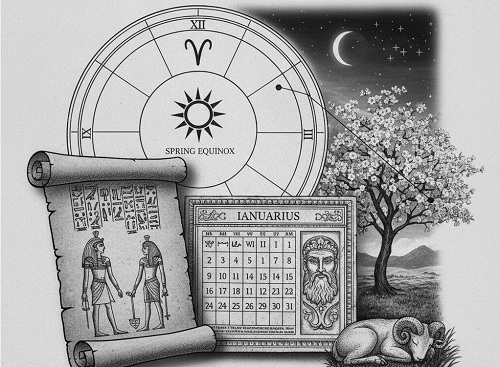
The Astrological New Year: A Journey Through Time and Stars
The Egyptian Foundation
In ancient Egypt, the New Year commenced on the first day of the month of Thout, coinciding with the heliacal rising of Sirius around July 19 or 20 on the Julian calendar. This sacred month was dedicated to Thoth, the god of wisdom, writing, and hidden knowledge.
The Egyptian calendar originally consisted of twelve 30-day months (360 days), supplemented by five “epagomenal days” at the year’s end. These five days belonged to no specific month; instead, they were reserved for grand celebrations honoring the deities Osiris, Horus, Seth, Isis, and Nephthys. This 365-day system provided a foundational attempt to synchronize human time with the solar cycle, eventually influencing both Greek and Roman timekeeping.
Roman Transitions and the Julian Reform
The tradition of beginning the year with the Spring (Vernal) Equinox dates back to the early Romans. Their original ten-month calendar began in March, the month when the sun crosses the celestial equator. However, in 45 BC, Julius Caesar sought to stabilize the Roman calendar, which had fallen out of sync with the seasons.
Guided by the Egyptian astronomer Sosigenes, Caesar introduced the Julian calendar. This system established a 365-day year with a leap year every four years. Caesar also shifted the New Year to January 1 to honor Janus, the two-faced god of doorways and beginnings. While this provided political and administrative structure, it distanced the civil year from the natural, astronomical cycles of the earth.
The Gregorian Correction
By the 16th century, the Julian calendar had drifted significantly. Its calculation of the solar year was off by approximately 11 minutes and 14 seconds annually, creating a ten-day discrepancy that affected the timing of Easter and other religious festivals.
In 1582, Pope Gregory XIII introduced the Gregorian calendar to rectify this lag. He famously skipped ten days in October and refined the leap year rule: century years would only be leap years if divisible by 400. While this calendar is the global standard today, it remains a purely mathematical construct rather than a biological or astrological one.
The True Astrological New Year
Despite these historical shifts in civil timekeeping, the Astrological New Year remains anchored to the cosmos. It begins at the Spring Equinox in the Northern Hemisphere; the precise moment the Sun enters the sign of Aries.
• Nature’s Rebirth: Spring (in the northern hemisphere) represents a literal resurrection, a time of procreation, rising temperatures, and the awakening of flora and fauna from winter’s dormancy.
• The Biological Clock: In medical astrology, Aries governs the head, the seat of consciousness and the “top” of the human body.
• Symbolic Alignment: It is far more symbolic for the year to begin with the “head” (Aries) during the revival of nature, rather than during the Sun’s transit through Aquarius (January), which governs the ankles and legs.
In essence, while emperors and popes have redrawn our calendars for centuries, the solar cycle continues to dictate the true rhythm of life. The entry of the Sun into Aries remains the authentic start of the journey—a moment of fire, initiative, and the eternal return of the light.


Leave a Reply