
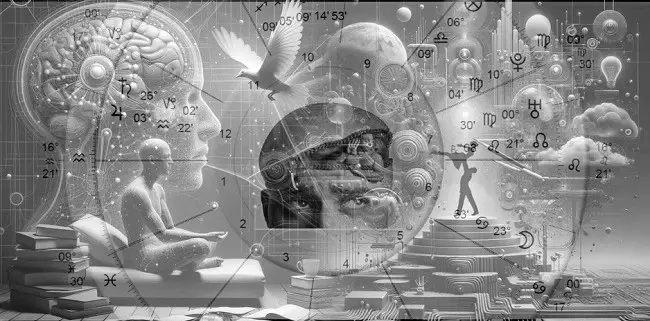
Ontology & Astrology
Ontology is a branch of philosophy that deals with the study of being, existence, and the nature of reality.
The concept of ontology dates to the beginning of philosophy, with its origins in ancient Greece. Philosophers such as Plato and Aristotle laid the groundwork for ontology by considering the nature of being and what it means to exist. Plato (circa 428–348 BC) examined the existence of ideal forms or abstract entities, suggesting that reality is more than what we perceive with our senses. Aristotle (384–322 BC) is often considered one of the first philosophers to systematically address ontology in his work Metaphysics. He explored the concept of “substance” (ousia) and how different entities, and their properties exist, categorizing them into different types of being.
Fifteen hundred years later during the medieval period, philosophers such as Thomas Aquinas (1225-1274 AD) expanded on these ideas, particularly those concerning the existence of God and the nature of reality in relation to faith and reason.
The term “ontology” itself was coined much later and is attributed to the German philosopher Christian Wolff (1679-1754). He used it in his work Logic (1712) to describe a branch of metaphysics related to the study of existence or being in the most general sense.
Beyond the depth of the concepts that ontology handles, what should surprise us is that today these concepts analyzed more than two thousand years ago are used today in computing and more specifically in the development of artificial intelligence (AI).
To understand this, we must mention what are the questions that ontology addresses, which are the following:
What entities exist?
What is the nature of these entities?
How do they relate to each other?
In simple terms, ontology explores what things are, how they can be categorized, and how they interact within the world. And among the key aspects we can say that it tries to define the fundamental categories of existence, such as physical objects, abstract concepts, processes, or events. In terms of the relationships between parts, it investigates how different entities connect or interact, the process of cause and effect, or how properties are linked to the objects they describe. It explores what it means for something to exist, what constitutes reality, and how things are real in different contexts.
When we mention artificial intelligence (AI), it would be used to define categories such as “Person,” “Place,” and “Event” and the relationships between them.
Now, do ontology and astrology have anything in common?
Both disciplines belong to very different fields: ontology is a branch of philosophy that studies the nature of being, existence and the fundamental categories of reality, while astrology focuses on the interpretation of the movements and positions of the stars as a way of understanding human and natural events.
Despite their differences, conceptual relationships can be found between both:
Astrology is based on the idea that celestial bodies (planets, signs, and aspects) have an influence on the destiny and personality of individuals. In this sense, it could be seen as a way of conceiving the human “being” in relation to the cosmos. Ontology also deals with the relationships between beings, although from a more abstract perspective.
Ontology asks what it means to “be,” and astrology could be seen as an answer that connects human beings to a “cosmic being,” where stars and planets represent forces or entities with influence on human existence.
Ontology also deals with the problems of determinism and free will, questioning whether events are predetermined or whether individuals have the power to choose. In astrology, the position of the stars at the time of birth is interpreted as a predestined map that influences personality and events in a person’s life, which could be considered a form of cosmic determinism, although with the application of free will, consciousness can be raised and certain predeterminism’s that exist can be overcome.
Here, the link between ontology and astrology is given in the question of whether our lives are determined by a cosmic structure or whether we are free agents with the ability to change our existence.
From an ontological perspective, there is a debate between the material and the immaterial, and how immaterial entities (such as thoughts, emotions or ideas) relate to physical reality. Astrology could be seen as a discipline that connects these two planes, by interpreting celestial influences (a physical phenomenon) on the immaterial dimensions of the human being, such as personality and emotions.
Thus, both ontology and astrology seek to understand the relationship between the physical world and subjective or spiritual experiences.
One of the foundations of astrology is that the stars have a direct influence on people, a concept that, from an ontological perspective, can be interpreted as a connection between the individual and the cosmos. That is, the human being is not an isolated entity, but is part of a network of cosmic relationships, and the study of these relationships is a way of understanding the nature of the human being.
From an ontological point of view, this idea is close to the notion of “relationality”, in which entities do not exist in isolation, but their existence is defined in relation to other entities. Astrology, when considering the interaction of the stars with the individual, could be understood as an extension of this network of relationships.
Astrology, like ontology, poses a worldview, a particular way of understanding the place we occupy in the universe. Astrology does so through the study of the heavens, while ontology can do so through philosophical reflection on existence. Both, in some way, offer us a way of conceiving our position in the world and in the cosmos.
In short, although ontology and astrology operate from very different perspectives, points of connection can be found in the reflection on being, cosmic influences and the determination of human existence in relation to the universe. Astrology, in this sense, could be seen as a symbolic interpretation of the human being in his interaction with the cosmic, while ontology seeks to understand the most fundamental principles of that existence, in a more abstract and philosophical search.
It puzzles that so much ancestral knowledge is not widely disseminated or practice today. The information is available, all that remains is to use our free will to use it and improve our ephemeral existence on this plane.


Leave a Reply